
Beyond the Bot: The Future of AI in Enterprise Automation (2026)

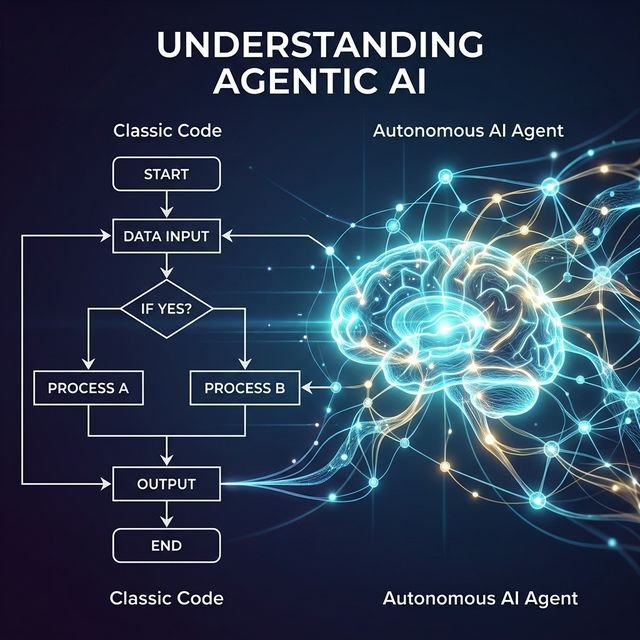
Imagine a massive factory from the 1920s. To make a single car, you needed a "Assembly Line." Every worker stood in one spot and did one task: one person tightened a bolt, the next person added a door, and the next person painted the hood. If one worker got sick or the line broke, the entire factory stopped. This is how "Traditional Automation" has worked in businesses for decades.
Today, we are moving from "Assembly Lines" to "Autonomous Workforces." In this new model, you don't have a line; you have a fleet of smart robots that can talk to each other, solve problems on the fly, and decide how to build the car themselves. This is the future of Enterprise AI Automation.
The Shift from "Rules" to "Reasoning"
In the old world of automation, we had to write "Rules." If the customer says X, then do Y. But the real world is messy. Customers don't always stay "on script." They have unique problems that don't fit into a simple rulebook.
Agentic AI is different because it can Reason. It doesn't just follow a rule; it tries to understand the intent behind the request. If a customer sends a confusing, angry email, a rule-based system would crash. An Agentic AI will pause, identify the core problem, and find a creative way to solve it.
Three Pillars of the AI-First Enterprise
- Interconnected Agents: Instead of having one giant AI, companies are building "Agent Clusters." A "Sales Agent" talks to a "Legal Agent" who talks to a "Billing Agent." They work together just like human departments do.
- Model Context Protocol (MCP): A new way for AI to "plug into" corporate data safely. It allows the AI to see the company's Salesforce, HubSpot, or Slack data without the company ever losing control of their security.
- Continuous Learning: Enterprises are no longer just "using" AI; they are training it on their own internal knowledge. The AI gets smarter every day by watching how the best human employees solve problems.
The "Invisible" Office
In 2026, the most successful companies will have "Invisible" departments. You won't see 50 people doing data entry or 20 people processing invoices. Those tasks will happen in the background, handled by a fleet of digital agents. The human "Managers" will spend their time supervising the AI, setting new goals, and handling the 5% of cases that require true human empathy.
Conclusion: Preparing Your Business
If you are a business leader, the question is no longer "Should we use AI?" The question is "How do we architect our AI?" The companies that win will be those who bridge the gap between their "Legacy" systems and the new "Agentic" workflows.
At aiminds.school, we provide consulting and training specifically for enterprise teams. we help you identify the "High-ROI" workflows that are ripe for automation and show your team how to build safe, scalable AI systems that actually deliver value, not just hype.
Want to future-proof your enterprise? Our proprietary "AI Maturity Audit" helps you identify the gaps in your current automation strategy and provides a 6-month roadmap for Agentic integration.
Suggested reading


Frequently Asked Questions
How is "Enterprise AI" different from regular AI?
Enterprise AI is built for "Scale," "Security," and "Consistency." While a regular user might use AI for a one-off task, an enterprise uses AI to run millions of automated processes across different departments, requiring strict data privacy and integration with existing corporate software.
What is the biggest challenge for AI in the enterprise?
The "Hallucination" problem is the top hurdle. In a business setting, a 95% accuracy rate is often not good enough. Companies are using "Human-in-the-loop" systems and "Fact-Checking Agents" to ensure that the AI never makes a high-stakes mistake.
Will AI replace traditional RPA (Robotic Process Automation)?
AI isn't replacing RPA; it is supercharging it. RPA handles the "Muscle" (clicking buttons and moving data), while AI provides the "Brain" (deciding what to click and understanding the context of the data).
Live masterclasses
Enroll in our live masterclasses programs: Build real AI agents or your first data-science model with expert mentors.
Agentic AI Developer Bootcamp
Structured agentic AI and LangGraph training — intensive bootcamp-style projects with mentor support.
Duration: 2 days, 5 hours each day.
Explore Agentic AI Course →Data Science Masterclass
Start your data science journey with a structured live masterclass and hands-on model building.
Duration: 2 days, 5 hours each day.
Data Science Masterclass →