
The Robot Family Tree: A Simple History of AI (2026)

Imagine you are looking at your **Family Tree.** You see your parents, your grandparents, and your great-grandparents. Each generation added something new—one taught the family how to build, another taught them how to speak, and yours taught them how to use the internet.
The **History of AI** is exactly like that family tree. The "Generative AI" we use today (like ChatGPT) didn’t just pop into existence; it is the grandson of the "Chess Machines" of the 1990s and the great-grandson of the "Logic Paradoxes" of the 1950s.
Using the **Feynman Technique**, let’s look at the three big "Growth Spells" of the AI family.
1. The Age of Rules (1950s - 1980s)
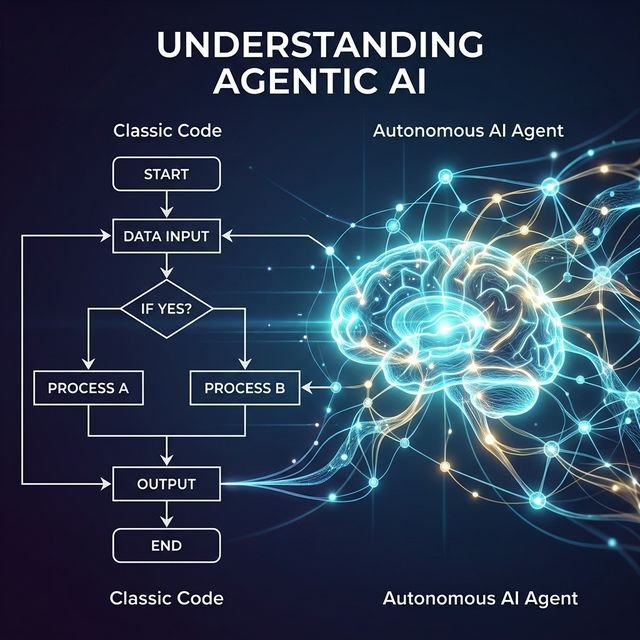
Early AI was like a strict teacher. It only knew how to follow "If-Then" rules. "If the user says Hello, Then say Hi." It was very organized but had zero imagination. If you asked it something not in the rules, it simply broke.
2. The Age of Statistics (1990s - 2010s)
This is when AI stopped following rules and started "Learning" from examples. Instead of being told what a dog looks like, it was shown 1,000,000 pictures of dogs. It became the "Master of Probability." This is how Google Search and Netflix recommendations were born.
3. The Age of Creation (2020s - Present)
Now, AI has moved from "Comparing" things to "Creating" them. It doesn’t just recognize a dog; it can draw a dog wearing a tutu in the style of Van Gogh. It has developed a "Creative Brain" that can reason and simulate the world.
Conclusion: The Family Keeps Growing
We are currently living in the most exciting chapter of the AI story. In 2026, we are seeing the birth of "Agentic AI"—machines that don’t just talk, but actually "Do." Just like your ancestors probably couldn’t imagine the internet, we likely can’t imagine what AI will look like in 50 years.
At aiminds.school, we teach you how to write the next chapter of this history.
Want to deep-dive into the technical evolution of AI? Join our AI Foundations masterclass and learn the math that transitioned us from "Rules" to "Reasoning."
Suggested reading


Frequently Asked Questions
When did AI start?
While humans have dreamed of artificial life for centuries, the formal field of AI began in 1956 at the Dartmouth Summer Research Project, where the term "Artificial Intelligence" was first coined.
What is an "AI Winter"?
An AI Winter is a period where progress in the field slows down because the technology failed to live up to the massive hype, leading to a loss of funding and interest. We have had two major winters, but the "Generative Spring" of 2022-2026 shows no sign of stopping.
Who is the "Father of AI"?
Alan Turing is widely considered the father of computer science and AI, thanks to his famous "Turing Test," which challenged machines to prove they could think like humans.
Live masterclasses
Enroll in our live masterclasses programs: Build real AI agents or your first data-science model with expert mentors.
Agentic AI Developer Bootcamp
Structured agentic AI and LangGraph training — intensive bootcamp-style projects with mentor support.
Duration: 2 days, 5 hours each day.
Explore Agentic AI Course →Data Science Masterclass
Start your data science journey with a structured live masterclass and hands-on model building.
Duration: 2 days, 5 hours each day.
Data Science Masterclass →