
If you're unsure what Agentic AI is and what's the difference between types of automations

We hear it every day from developers and business leaders alike: "I want to implement AI automation... wait, I mean an AI workflow... or maybe I need an AI Agent?"
If you are trying to figure out the differences between these three terms, you are not alone. The line between them often blurs, especially when marketing teams get involved. The difference between them comes down to a fundamental concept: The Autonomy of Decision-Making.
Using the Feynman Technique—distilling complexity into plain English—let's break down exactly what Automation, AI Workflows, and Agentic AI are, and explore when you should (and shouldn't) use them.
Level 1: The Train, The Self-Driving Car, and The Human Driver
The easiest way to understand the difference is through an analogy of transportation.
- Classic Automation (The Train): A train is incredibly fast and perfectly reliable, but it can only go where the tracks have been laid. If a tree falls on the tracks, the train stops. It cannot navigate around the problem.
- AI Workflow (The Self-Driving Car on a Highway): A self-driving car stays in its lane and follows a pre-programmed route, but it has the "fuzzy logic" to recognize patterns—like slowing down if someone merges into its lane. It handles predictable complexity excellently, but it still relies on a fixed map.
- Agentic AI (The Human Driver): A human driver is given a goal: "Get to the grocery store." If a road is closed, the human recognizes the closure, pulls out a map, calculates a detour, avoids a pothole, stops for gas, and still arrives at the store. It is fully autonomous and highly adaptive.
Level 2: The Technical Breakdown
Let’s look at the technical definitions of these three tiers.
1. Classic Automation
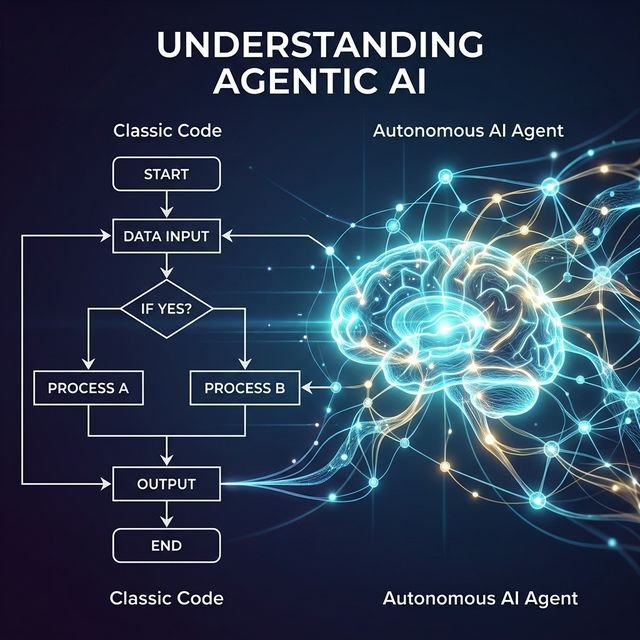
This is the simplest form of "getting stuff done automatically." It executes predefined, rule-based tasks using strict Boolean logic (If X = True, Then do Y).
- Strengths: It delivers 100% reliable outcomes. It is blazing fast to execute and incredibly easy to debug.
- Weaknesses: It is limited to tasks explicitly programmed. It cannot adapt to new scenarios or handle complex text analysis.
- Example: Sending a Slack notification every time a new lead signs up on your website.
2. AI Workflows
An AI Workflow is a step up. It is a deterministic program that "calls" an LLM (like ChatGPT) via an API for one or more specific steps in its journey.
- Strengths: It brings the pattern recognition of AI into a structured environment. You get the flexibility of fuzzy logic mixed with the safety of rigid rails.
- Weaknesses: Because the LLM step is probabilistic, it is harder to predict and interpret if the AI misunderstandings the data.
- Example: When a new lead signs up on your website, you pass their profile to an LLM, ask it to "Analyze and score this lead from 1-10 based on buying intent," and then route the lead to your sales team based on that score.
3. Agentic AI (AI Agents)
Agentic AI is the most advanced—and also the riskiest—option. These programs are designed to perform non-deterministic tasks autonomously. They don’t just follow a predefined path; they determine their own next steps based on previous outcomes.
- Strengths: Highly adaptive. Simulates human-like problem solving and reasoning. Can execute multi-step workflows without a developer laying the "tracks" beforehand.
- Weaknesses: They frequently sacrifice reliability for flexibility. They are slower to execute, harder to debug, and can produce unpredictable outcomes if they go off the rails.
- Example: Give the agent the name of a new lead. It autonomously decides to perform a full internet search, reads the lead’s recent LinkedIn posts, queries a database to see if their company is hiring, determines what software they might need, and crafts a highly personalized outreach email—without ever being explicitly programmed on how to gather that specific data.
Level 3: Finding the Right Balance
Often, beginners try to build a fully autonomous Agentic AI to do something that simple automation could do in a fraction of the time.
If you just need something predictable, stick to classic automation. If you need text summarization or classification within a safe environment, an AI Workflow is brilliant. It’s only when you want to push the boundaries and handle highly dynamic, multi-step problem solving that you truly need an AI Agent.
As one developer noted: "Pure agentic AI often sacrifices reliability for flexibility. That’s why most practical enterprise implementations today use a hybrid approach—combining deterministic workflows with selective agent-like features for specific tasks."
Conclusion: Measure Twice, Automate Once
Before you dive into building an autonomous system, you must map out the workflow you hope to automate. A technique known as Goal-Oriented Task Analysis involves clearly identifying the desired outcome before choosing your tools. The technical "how" must always be subservient to the business "why."
If your goal is sending a simple notification, build the train tracks. But if your goal requires dynamic internet navigation, adaptive problem solving, and tool orchestration, then it is time to build an Agent.
Want to master the difference between AI Workflows and True Agentic AI? Join our live Agentic AI Developer Bootcamp to learn how to design, build, and constrain powerful autonomous agents for enterprise use.
Suggested reading



Frequently Asked Questions
What is the main difference between Automation and an AI Agent?
Automation relies on predefined, deterministic Boolean logic (if X happens, do Y). An AI Agent relies on autonomy and fuzzy logic; it can independently determine its next actions based on previous outcomes and adapt to unexpected variables.
When should I use an AI Workflow instead of an AI Agent?
Use an AI Workflow when you need the pattern-recognition power of an LLM (like scoring inbound leads) but you still want the deterministic safety and reliability of a fixed path. Use an AI Agent only when tasks are highly dynamic and require autonomous planning.
Are AI Agents always better than traditional automation?
No. AI Agents often sacrifice reliability and speed for flexibility. For simple tasks (like sending a Slack alert), traditional automation is much faster, more reliable, and easier to debug.
Live masterclasses
Enroll in our live masterclasses programs: Build real AI agents or your first data-science model with expert mentors.
Agentic AI Developer Bootcamp
Structured agentic AI and LangGraph training — intensive bootcamp-style projects with mentor support.
Duration: 2 days, 5 hours each day.
Explore Agentic AI Course →Data Science Masterclass
Start your data science journey with a structured live masterclass and hands-on model building.
Duration: 2 days, 5 hours each day.
Data Science Masterclass →